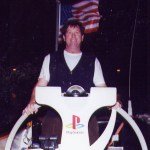
The Six-mile Three Tree

This photo by Arden Rathkopf pretty much tells the Three Tree tale. Arden is the 13-year-old son of proud father and CYC PRO Charley Rathkopf. Proud mom of course is Schelleen Rathkopf, owner of Whidbey Island Race Week.

The Center Sound Series was due a drifter, and the Three Tree Point race delivered. After a long delay, enough zephyrs came from the south to start the fleet of Saturday’s racers on a 6.something mile course.

A slow motion race ensued as the fleet did the usual tuck under the West Point beach and made its painful way around West Point, then off to Duwamish Head. It certainly wasn’t the rousing conditions most were hoping for to wrap up the series. Results here,.

Sonic Boom Hang

Most notable perhaps was Sonic‘s relatively slow motion grounding at West Point. After positively nailing the start and leading the IRC class to the beach, skipper Marek Omilian and the team took the port tack lift while clearing the lighthouse, taking Glory up with them in the process. “We got lulled into complacency by seeing all the boats around us safely clearing the bar. However, none of those boats draw 10.5’,” skipper Omelian reports. Glory headed down, taking Sonic‘s transom, just in time as Sonic hit bottom. Sonic was stuck as the fleet made its south way ever so slowly. Despite efforts including the crew perched on the end of the boom and trying to hoist a spinnaker, Sonic was stuck.

Stuck, that is, until photographer Jan Anderson and her “boat boy” Skip helped pull them off. This is yet another reminder of how Janpix helps out the racing scene around here (and how important it is to support her photography). Three Tree pix here. Apparently we need them out there for more than photographs.

Mark Omelian’s Sonic is not just a racer, it’s a charity fundraiser. Note the banner they displayed pre-start. Ormelian explains:

We are using Sonic TP52 as the platform to raise money for various programs in the Pacific Northwest through The Ocean Foundation (TOF). When you text OCEAN or SONIC to 91999 you get a text back with the invitation to contribute directly to TOF. Individual donations, along with corporate funds we are in the process of raising will benefit specific programs we are in the process of identifying. Fred Felleman (Port of Seattle Commissioner) and Peter Schrappen (NMTA) are advising us on the program selection. We are very passionate about the following three areas:

Marine Education – we identified Youth Maritime Collaborative as the beneficiary program. I am attending their event at Seattle Maritime Center today to learn more about their needs. Besides money donation, we plan to create an internship position.

Marine Safety - TBD

Marine Environment – TBD

We are always looking for input, so if you and your readers have any suggestions please let us know.

When the zephyrs cleared, Charlie Macaulay’s Absolutely won the race overall and class 8, which incidentally had seven of the first eight boats overall. More Jubilee won the three-boat tiebreaker among the J/105s, Sachem hung in well enough to win class 7 overall and Glory easily won the ORC class overall. Dos finished her class off with another bullet. In class 6, Don Leighton’s Tahlequah won the race and the series as class leader Elusive dropped to fifth for the race. Onboard was our intrepid weather guru Bruce Hedrick, who provided the following no-blow by no-blow race dissection:

Tahlequah’s Tale

By Bruce Hedrick from onboard Tahlequah

Well, it was a beautiful day on the water even though with just a .5MB pressure difference between Bellingham and Portland, we didn’t think there would even be a race. So we drifted around for a while and about 1110 we started to see a dark line extending to the west from West Point. The Race Committee also saw it and set a line and then hoisted the “S” flag with what we thought was a pretty optimistic course. Considering the time, tidal situation, and the forecast for less than existing wind it was going to be a stretch to even get back to F the first time.

Bruce Hedrick geared and waving pre-start.

I thought we had a pretty good start considering that we got tangled up with a J-120 who thought they were starting with us. After several of us yelled at him, he finally sailed off at about 30 seconds to go, leaving us one boat down from the heavily favored committee boat end. Darkside, the Shock 35, has been steadily improving this series and won the start however it wasn’t long until by going higher and faster we got into the lead. The series leader, the C&C 115 Elusive, went conservative at the start and was well to leeward of us and unable to point high, sagged off and was first into the outfall from the Ship Canal which set them back and slowed them down. We got into the shallows south of the Ship Canal and rather than tacking on anyone decided the best tactic was to sail our own race and find a clear lane to get up to the West Point Buoy.

In terms of who was where at this point, Darkside had gone a little further into the beach and closed up with us. The J-35 Solution and the other C&C 115 Fortuna had stayed out but gotten into the ebb coming around West Point and that set them back but since there was about two more knots of wind on the outside they didn’t lose much. Elusive had fallen well back and was starting to get tacked on by other boats which certainly didn’t help them. Rather than tacking back into the beach north of West Point, we stayed about three boat lengths off to keep our air clear and just try to get out to the West Point Buoy. It quickly became apparent that a major restart was developing at the WP Buoy and when boats tacked at the mark they pretty well parked up in the ebb. This was creating a picket fence effect so we just kept going out on port tack and kept our air clear as a nice port tack lift came through. The boats that did tack to starboard and could get back towards Magnolia did OK for a while but the stronger ebb along that shore slowed them down and then as the breeze backed from the SSE to ESE it lightened up in there as well.

We stayed out and watched as the big boats led by Glory came around behind us and then held port tack, going generally our direction. We also had sailed to leeward of Madrona and that put us in some good company in clear air. The other interesting feature at West Point that really helped the big boats was the fact that there was about 3 more knots of wind about 15-20 meters off the water. The big boats with square-top mains just kept moving. Crossfire was behind coming around the buoy but when they changed to the drifter and got a nice puff, they powered nicely into a lead they would never relinquish.

At this point, we were still on port tack just off of Four Mile Rock with the wind at about 100°M making about 1.3 knots over the bottom thinking that it was going to be a long day just to get to Duwamish Head. The wind continued to hold at about 3-4 knots but then began to clock around. The boats that had gone in under Magnolia, like Dos, parked up and gradually dropped astern. Darkside had rounded the buoy well too leeward and astern of us but, as Schock 35s generally do in 1-4 knots of wind, gradually went to leeward of us and got into the lead. Well behind was Solution, Fortuna, and Elusive generally sailing lower and slower. However, as we have painfully learned over the last couple of years you can’t put the C&C 115’s far enough behind on the upwind legs to hold them off when they put up the kites and get rolling downwind. Amazing what a carbon boat with more waterline, a lot more sail area can do going downwind. Especially so in this series as we had watched Elusive come from well astern, sail through our lee and then through Sachem’s lee to take the lead in the previous race.  

As the breeze continued to clock around to the SW it was just a question of when to tack towards Duwamish. There was more breeze to the west and if you tacked too early you would get back into the light stuff. So we waited until we could tack and be about 20 degrees low of Duwamish. We had also seen the RC boat come around West Point and head towards Elliott Bay Marina. We were thinking, those dogs are going to get lunch at Maggie’s Bluff and then go back to finish us off Shilshole but no, they continued on up to Duwamish Head. Now it was a one tack drag race to the finish.

Darkside had held on to port longer than we had, so as the breeze continued to clock we had a slightly better angle to the finish. After we tacked we also immediately set up a barber hauler to move the jib lead out and forward and once we went to that, we were able to slowly sail away from Darkside and get back into the lead.  We also started to get the crew ready for a spinnaker set as the newer boats around us went to their Code 0’s and really started to move nicely in conditions perfect for those specialty sails. Darkside was still to weather of us by about three boat lengths and just couldn’t stand to see us continue to boat speed away from them so they set a standard kite. We were ready to counter however the wind was still too far forward for our .6 to work so we just focused on constantly trimming for speed and moving the crew around below decks for the perfect angle of heel. Darkside had a little problem getting their kite to fill which slowed them down and forced them to sail lower. We used that as an opportunity to come up underneath them and put them directly astern of us by about three boat lengths. They then had to fall off even more which allowed us to boatspeed away from them and into another battle for clear air with two faster boats, an FT-10 and a Farr 395, coming in from astern. All the while, Dos had set a chute and went flying through our lee to get well ahead of us, again.

We managed to hold off the faster boats and finish just astern of Dos. Now it was a matter of seeing where the rest of our fleet finished after Darkside took a well-deserved second place. Solution had moved into third place with Fortuna next who was looking great flying a Code 0 and steadily moving away from series leader Elusive.

In the series, we had two seconds and a first for a series total of five points, with Elusive taking the silver with two firsts and a fifth for a total of seven, and taking the bronze was Darkside with a point total of nine.

Kudos to the Race Committee for getting it done in very difficult conditions.

Bruce’s Brief: March 22-24 and CYC Three Tree Point Race

The first week of spring was certainly interesting with my brother in LA calling to complain that Seattle was 10 degrees warmer than LA. We also had three days of consecutive high temp records and we are now over 2” behind for rainfall year to date. This will all change starting this afternoon as a cold front moves over the area. Take a look at the satellite picture and the Langley Hill Doppler Radar and you’ll notice a very nice correlation between these two and where the front is located as of 1300 hours today.

Usually, frontal activity at this point on the day before a race is a good thing, not so much today. As you can see from the surface charts, the low to which this cold front is attached is relatively weak(997MB), not very stable and will become weaker (1003MB) over the next 24 hours as it is dragged off to the northwest and degraded by the coastal buffer zone. This will create a problem for tomorrow as there will be some wind from the south in the morning however as the day drags on it will become lighter and lighter as the pressure gradient expands over the Salish Sea.

Tidal Current at West Point

0818     .34knts                    Ebb

1336      Slack

1636      1.00                          Flood

1918      Slack

So while we may have wind for the start, it certainly looks like we won’t be able to complete the long course as two models have the Sound pretty well glassing-off by mid-afternoon. Maybe we’ll sail a shortened course. Who knows? There will be some rain around so dress accordingly and enjoy the day. 

Scatchet Head Race - Gorgeous, Tactical

After last week’s windy Blakely Rock Race, CYC’s Scatchet Head (the second of three Center Sound races), the fleet was looking forward to another sunny day but maybe a hair less excitement. Puget Sound delivered last Saturday.

The fleet spread across the Sound on the 10-knot beat to the Scatchet Head buoy. West was clearly bestfor some, east worked for others. Puget Sound can confound. For everyone, the run home was delightful, especially for those who stayed west. The wind was a little lighter until the northerly started to roll down the Sound later.

In the IRC it was again Glory winning. It was TP 52 conditions (are there any conditions really NOT for a TP52?) Smoke was second and Crossfire third. Our friends on Crossfire found it tough to hang with the TPs in the light conditions. “We made some time up on the downwind leg, but once it got back in to the 4-6 knot range downwind, we really couldn’t real them in,” Nigel Barron board Crossfire reported.

Photos courtesy of Jan Anderson. See the rest here.

Results

If last week’s crew overboard incident aboard the Flying Tiger 10 Anarchy was exciting in one way, the Scatchet Head Race was about as exciting in different way as they slid home for an overall PHRF fleet win. Owner/skipper Tom Ward reported:

It was ideal conditions for the light boats.  On the beat we stayed the west side going up with Bat Out Of Hell (BOOH), Sachem and Izakaya (another FT10) working our way through the fleet. I believe we were around 9th PHRF boat to round with BOOH leading our class. After rounding we stayed hot, working west. We did a couple of gybes out to the east and back as Sachem continued on working west and closed the gap on us and Izakaya.  We saw BOOH had gone way east and fell well behind. Sachem was keeping pace but at that point not closing the gap.

We keep trading jibes with Izakaya reeling them in slowly by trying to stay a few degrees hotter than them. It was a great battle and forced both boats to sail at their best. I believe we finally jibed inside them and then back to get in front of them about 20 minutes from the finish. They tried going further out before gybing to the finish for a hotter angle and did close the gap as we soaked down to stay between them and the finish crossing just 30 seconds ahead.

Elsewhere in the fleet, Ace and Absolutely had an epic battle right to the finish, with Ace barely taking the class gun and winning by 10 minutes on corrected time. The entire J/105 fleet finished within 15 minutes and head into the final race with threeway tie for first place between Jaded, More Jubilee, and the Racers Formerly Known as Here & Now. Gaucho and Kiwi Express enjoyed a match race in Scatchet Head and are tied going into the last race.

Brad Greene’s Nordic 44 Kinetics enjoyed a very good race in PHRF 5, finishing third. Of course Dos ran away with the class with Different Drummer second. Considering Greene lives aboard the Perry design (no doubt a few extra pots and pans aboard), his fourth in class is pretty remarkable. Greene reports:

The start for our class 5 was light but we still got a decent start considering what it takes to get our 24,000 pound beast moving. Most of the fleet headed west as expected likely hoping Bruce’s weather brief would hold with more wind on the west side. We ended up tacking back out into the middle and then decided to go east on a flyer in part to avoid some north and south bound commercial traffic and to avoid getting pinned on the west side tacking up the beach. For a while it looked like we were doing well. Then the wind went light and we just didn’t have the power to keep the Nordic 44 moving.

We finally rounded Scatchet Head buoy and had a wonderful run home. We made up some time on a few boats in part I think because the wind started to fill in from the north again getting to us first. The only complaint on board Kinetics was the windchill upwind was a bit icy even with the sun trying its best to heat things up. Big thanks CYC for making it a great #2 for this CYC CSS.

From CYC’s standpoint, the only hitch for this race came in the form of a reminder that we all share the water with commercial ships. Fleet Captain Matt Wood reports, “The only remarkable aspect was the amount of attention the fleet garnered from deep draft pilots and Washington State ferry masters. It is critical that competitors monitor both the race channel (in this regatta, that is  VHF 69 ) and Seattle Traffic VHF 14. On the RC boat we were reaching out to the fleet to ensure Colreg Rule 10 compliance, as well as transitioning vessels were on 14. Everyone needs to be diligent in this regard.”

With two good races in the books, it’s on to the penultimate Three Tree Point Race in two weeks. Could it be three gorgeous races in a row? Check in the day before for Bruce’s Brief.

Bruce’s Brief for March 8-10 and Scatchet Head Race

Some weather guru, watching pigs in HI while we watch snow.

While we may have had some rain or snow earlier this week, it looks like we are in for another lovely day on the water this weekend. The problem will be for Scatchet Head racers that there won’t be as much wind as last weekend. As the most recent frontal system has gone past the Pac NW, it has left us with a very weak and wandering ridge of high pressure system (1020MB) that will result in little to no pressure gradient over the area. While there is a weak southerly at West Point this morning, the pressure is rising so it will gradually move around to the east before becoming light and variable. This will persist overnight and then the question becomes when and how much northerly will come down the Sound on Saturday. The answer will be for racers (and the Race Committee) to check the pressure gradient from Bellingham to Seattle and Bellingham to Portland.

As of 1000 hrs PST Friday the gradient looks like this:

Bellingham       1016.8MB

Seattle             1016.9MB

Portland           1016.6MB

Take the difference between the readings of Bellingham to Seattle and multiply times 5 to get approx wind strength over the north Sound. Any differential less than 1MB says it’s going to be very light. Take the difference between Bellingham and Portland and multiply times 10 for the approx wind over the central and south Sound. The wind will flow from areas of higher pressure to areas of lower pressure, so that tells the direction.  This will be the best way to figure out the answer to how much and when. Once again, as this a transitional period, the models are not in agreement. Two models show some semblance of a northerly starting to fill around noon and then building to a more reasonable 10 knots by 1400-1500 hrs.

Once again tides will not be bad. I use the current at Foulweather Bluff for what will be happening at Scatchet Head. It’s not an exact match but it is certainly close enough.

0948    .67 Ebb

1312    Slack

1600    1.01 Flood

1930    Slack

Satellite View - Click to enlarge

I also look at Point No Point because of the timing of the flood tide for the simple reason that the flood starts on the west side of the Sound first. So, if because of wind direction, there’s a question about which way to go, head west. There will probably be slightly more wind on that side as well.

Current. At Point No Point

1018    1.38 Ebb

1354    Slack

1554    .49 Flood

1854    Slack

All in all, it should be a nice day on the water, a little cool but not freezing.

Have fun and be safe.  

Ed. Note: Last week after Bruce’s Brief, alert reader Dan Tedrow asked for a list of resources. Check out Bruce’s response by going back to that Brief and scrolling all the way down.

Blakely Rock Kicks off Center Sound with Great Conditions and a Fleet MOB Response

CYC’s Blakely Rock Race is the unofficial start to the year’s racing season. Sure, there are frostbites the South Sound Series, but those seem to be winter. As such, if you’re looking for an omen for the year to come, it’s going to be an interesting one, and a good one. After all, it’s not every race you have to restart and a (successful) man overboard recovery, but such was the case last Saturday in Puget Sound.

The day started out as Bruce predicted, bright and breezy. PRO Charley Rathkopf set the weather mark to the north and started sending off the classes. He soon was informed the mark was headed for Spring Beach and made the decision to restart and use a shorter course.

All photos by Jan Anderson. Click here to see and buy them. Click on any image to enlarge.

The reverse (small boats first) start made for a compacted fleet as they headed downwind. The planing boats planed and the cruiser racers just went fast, giving everybody a memorable start to the season.

Rescue by Committee

The biggest event of the race wasn’t the winner’s circle, it was the rescue of Anarchy crew Lindsey Lind. I haven’t yet been able to talk to the Anarchy crew or the crew of the TBird Selchie, the boat that ultimately picked Lind out of the drink. But here’s what I do know.

On the downwind leg, relatively close to the Blakely Rock, Lind fell overboard from the FT 10 Anarchy. Somewhere in there Anarchy broached. There were some chaotic radio transmissions from Anarchy to the Coast Guard, and then several boats in the fleet responded. Marek Omilian, the skipper of a the new-to-town TP 52 Sonic, saw Lind in the water about 500 yards ahead but wasn’t sure it was a person until they were 100-150 yards from her. By then the crew was already preparing the M.O.M. module and deployed it close enough that Lindsey was able to grab it. It turns out Omilian is a veteran of the Clipper Around the World Race and his crew was well prepared for a man overboard situation.

In the meantime Charlie Macaulay’s Absolutely also saw what was going on, dropped their chute and motored toward the victim. Macaulay recalled, “When we  still about 10 boatlengths away, Selchie executed a perfect kite douse and circled the MOB, turning up to leeward of her. They quickly pulled her onboard as we approached within a couple of boatlengths.” Absolutely was awarded 4 minutes redress for standing by.

Not everything was quite as seamless aboard Selchie as it appeared from the outside. Crew member Gail Tsai reported on Facebook: “The kite came down before I could release it from the pole; our green line went under and hooked to the keel while the halyard got caught with spin halfway up. It fell into water, got wet, and started pulling me off the boat. It had wrapped itself around my right leg. I was just clinging to everything for dear life trying not to cause another rescue. Never been so close to falling in the drink before.’

All’s well that ends well, and this one ended well. Lind was warm, dry and in good health in the CYC clubhouse after the race.

There has already been some discussion about the incident, and what lessons are to be learned. It seems to me that the racers can take pride in the rescue. The fleet responded immediately and skillfully. I understand there was a J/105 that also stood by in addition to the boats already mentioned. It’s interesting that one of the fastest rated boats (Sonic) and the slowest rated boat (Selchie) were both instrumental in the rescue. This might be a good argument for having a reverse start - keeping the fleet together longer on the racecourse.

New to Town with a bit of Irony

You might wonder how this TP 52 Sonic came to be here in the PNW, on Blakely Rock, and with a crew ready to play a vital role in the rescue. After all, it’s not as if the owner Marek Omilian is isn’t a household Seattle racing name like John Buchan (Glory), Steve Travis (Smoke) and Steve Johnson (Mist). I was wondering.

It turns out Marek Omilian may not be a household name yet, but it would be difficult to imagine a more prepared offshore racer owner. He recently completed the Clipper Round the World race on Visit Seattle, sailing all the legs. In fact, five people onboard Sonic on Saturday have done part or all of that race or are going to do it. Part of the Clipper preparations is “safety procedures ad nauseum.” So much of the crew was ready when they saw the person in the water.

Omilian, originally from Poland, says he’s developing an onboard culture based on safety, respect, teamwork and commitment. He’s also pursuing an interesting facet to the Sonic campaign; he’s looking to use the boat as a fundraising tool for good causes. Omilian has identified potential groups such as the Ocean Foundation and is approaching local corporations to see if a sponsorship program can be developed.

Now for the irony. Man overboard (or crew overboard - COB - as I’ve just learned I’m supposed to say) safety issues are much on the mind of racers these days. A thorough report was just released on the death of Jon Santorelli who drowned after falling off the TP 52 Imedi shortly after the Chicago-Mac start last year. Sonic is Imedi, and so it seems fitting that the boat, with a safety-focused crew and skipper, helped in this successful rescue.

The Racing

As far as the racing goes, the consistent breeze emphasized boatspeed and boat handling. There were nine classes, including a 1-boat multihull class. Results here.

Brad Butler’s very well-sailed Sierra 26 Dos planed to another victory, correcting easily on her class and by over a minute overall. The six second ding to her rating, pronounced in the January PHRF meeting, wasn’t nearly enough for Saturday’s conditions. When the Sierra gets on a plane, the boat is pretty much a gun in a knife fight.

Winning the Boats with Cabins division was Bill Buchan’s Sachem demonstrating how it’s done. The Peterson 43 charged along in the heavy upwind conditions and held her own downwind, correcting by nearly eight minutes ahead of the rest of her class and only a 1:24 behind Dos.

Within the classes, there were a few interesting results. The 9-boat J/105 class was won by Racers formally known as Here & Now. The J/29 Boat of the Year bunch have apparently moved on to One Design. Also, the level 72 (PHRF rating) class has made a reappearance, and it was won by the C&C 115 Elusive with the J/35 Tahlequah second and the Schock 35 Darkside third. It will be interesting to see if this class can stay together as a group and, hopefully, build.

Perhaps the most competitive of the classes was class 8. Burzicki/Shorett’s Farr 395 Ace corrected to first, with Absolutely second and Andy Mack’s J/122 Grace third. The three finished within 11 seconds on corrected time and finished fourth, fifth and sixth overall. In the proverbial race-within-a-race, the J/122 Grace and the Farr 395 Ace, had a few close crosses before Ace ultimately finished overlapped.

Mike Johnson, crew aboard Ace, recounted: “We had a good day sparring with Grace, a boat with many good sailors and friends. They had a great start and first beat to begin the run with a 100-yd lead. We were able to reel them in after a few big puffs filled in from the north and rounded Blakely Rock just ahead. Upwind, we stayed on port while they took a tack toward Wing Point and then held a higher port tack lane across the Sound.  There was a slight left shift, but not enough for them to pass. From the tack at Discovery Park we were always close and ended up overlapped at the finish. One advantage of having another equally rated and well-sailed boat is the opportunity to learn new things, which is what keeps us coming back.

Don’t you just love rivalries? All rivalries will resume in the next two Center Sound races. Bruce Hedrick will be providing his weather magic the day before each race, so check in then.

The Round the Buoys Center Sound Finishes With Three Tree Point

Corinthian YC’s Center Sound predictably kicks off the central Puget Sound racing season with three medium distance, one buoy rounding, 20-30 mile races. And, it seems usually, one race ends up a drifter and one a gear buster. 2018 had some different things in mind. Saturday’s Three Tree Point Race, which usually takes the fleet from Shilshole to Des Moines and back, was rerouted back and forth and up and down the central Sound so that it could be easily shortened if the wind died.

“I was a bit disappointed not to sail down to Three Tree,” Gaucho skipper John Cahill admitted, “but in the end liked the course.” Gaucho liked the course to the tune of first in Class 3 ahead of arch rivals Here & Now and Kiwi Express.

The course took the fleet to Blakely Rocks, across to Duwamish Head, to a temporary mark off Edmonds, back to West Point and finish for a total of nearly 27 miles. According to Cahill and others, the most interesting thing was reaching across the Sound. “The reaches were fun,” Cahill said. “It was marginal between going with a spinnaker or headsail. I have a cut-down Melges 24 asymmetrical that I don’t get to use often, but with that on board it was an easy decision.” They passed boats on the reach to Duwamish and reach back to West Point, then sailed on pins and needles avoiding the wind holes that kept appearing and disappearing while being hunted by their class.

Gaucho’s duel with Here & Now can be seen on this RaceQs file. Click on link below.


To see the raceQs replay, click here.

In Class 3, there’s not a lot of room for error. It is arguably the most competitive, closely rated and fun handicap class in the Seattle scene right now. Gaucho, Here & Now, Kiwi Express and Madame Pele were neck and neck for the whole series. They’re all racer-cruisers, and while they are all different, they have basic performance parameters in the same ballpark. It harkens back to the day when performance curves weren’t so dissimilar and the racing that much closer on the water.

Crossfire‘s Nigel Barron, who is no fan of the round the buoys racing in Center Sound (for Crossfire, anyway), admitted the alternative course for Three Tree wasn’t a bad one. “The wind did lighten up, and it was nice to do something different in that reach from Blakely Rock to Duwamish Head,” Barron said. He went on to ponder an alternative course for the supercharged ORC class, which is currently made up of the fastest boats in the fleet - “When the ORC class is not scored for overall, why couldn’t they have the fast boats do something different?” Something for race committees to think about considering the amazing speed of the fastest boats out there, even in the lightest of winds.

Unfortunately, photographer Jan Anderson’s Boat Boy Skip was down with the flu, so none of her great photos are available. I scoured Facebook to see what photos I could find from this year’s race, and this is what I came up with. Dave Reid, Melissa Davies and Robert Hodge get the credit for the pix! If you have any to share, please send them to me and I’ll add to this gallery.

There weren’t many other changes in the class standings from the previous two Center Sound races. Glory, Sachem, Selchie, Green Flash and More Jubilee won their classes handily. Kowloon, Here & Now and Dos had hard-fought series wins. Class 7 saw an epic battle between Joy Ride and Madrona with Absolutely not far behind. Fittingly, in the end it was John Murkowski’s Joy Ride breaking the tie for the class win but Carl Buchan’s Madrona taking the overall top boat spot. Joy Ride was second in fleet, Dos third and Sachem and More Jubilee tied for fourth.

Class results here. Overall results here.

CYC’s Race Fleet Captain Matt Wood was happy, particularly with the turnout. “Over 80 boats total in ORC, Casual and PHRF classes entered the series, easily the most participants the event has seen in several years.” He did admit to some glitches along the way but was pleased with how the races were managed in light of the ominous weather forecasts.

Bruce’s Brief’s: Wx for 23, 24, & 25 Mar, CYC Three Tree Point Race and a quick look ahead to South Straits.

Welcome to springtime in the Pacific Northwest! Last night it was spin the weather wheel and don’t be surprised at what comes up. Rain, snow, sleet, hail, and localized gusty winds all made guest appearances depending upon where you were. That is, however, spring in the Pacific Northwest.

This mornings surface analysis chart shows a weak area of low pressure (1000MB) with an attached frontal system just off our coast. Normally this would bode well for wind tomorrow, however, check the 500MB charts and you will see that the jet stream will drag this system slowly to the south and weaken it overnight. Instead of the low moving through the Salish Sea, it will come ashore near the southern Oregon coast late Saturday and disappear by Sunday. This system will still supply some wet weather over the weekend. The High-pressure (1030MB) you see off of Northern California will build and drift slowly to the East giving us some nice weather and warming temperatures next week. Look at the 500MB charts and as you can see, the jet stream will come across the Pacific at 30N-35N picking up the warmer air before arcing over that high and coming into our area. Low-pressure systems will still come into our area however they are weakening.

As for the Tree Tree Point Race, there will be tides, just not very much of them. At least they’ll be against us.

Tidal Current at West Point.

0748 Max Flood .53 knts

1024 Slack

1200 Max Ebb .29 knts

1406 Slack

2024 Max Flood 1.01 knts

The models are in agreement about what will happen tomorrow. They are NOT in agreement about when it will happen, not unusual. The basic situation is that we’ll start in a light (5-10 knots) southwesterly, it will get light about mid-day before it finally fills down from the north at 5-10 knots around mid-afternoon, winds generally closer to 5 than 10. Very little time under spinnaker but a lot of time beating. The Univ of Washington model is more optimistic with winds closer to 10 than to 5. With the GFS model, I have Crossfire around the course in just under six hours. The Race Committee did the right thing the last time when it looked like it was going to get flukey, I suspect they’ll do the same tomorrow. As my friend Nigel says, “There’s no real racing south of Alki.” The wind will be better in the central Sound north of Alki and south of Kingston.

Having said that, the problem is that as the wind goes into transition, it will die on the east side of the Sound first which will make marks placed there (Duwamish Head, Buchan Buoy, Pt. Wells)challenging.

Click to enlarge

A look deep into the crystal ball for next weekend, South Straits of Georgia. The high-pressure that is setting up offshore will tend to drift to the northwest and the gradient will ease over the area. The start is liable to be light on Friday however it does appear that by Friday afternoon the gradient will tighten and there should be a nice northwesterly over the race course. So for now, and remember woefully inaccurate, it doesn’t look like a gear buster. We’ll have a special South Straits update this Thursday, with a regular Bruce’s Briefs on Friday.

Have a great weekend.


Center Sound So Far, from Different Drummer

Few Puget Sound boats have been sailed so consistently well over the past few seasons as Different Drummer. The nearly 17K pound Wauquiez C40S is pretty much the prototypical modern cruiser-racer. Comfortable, solidly built and well behaved, she sails to her 81 PHRF rating and is one of the few boats in that rating band to regularly give fits to the 1000 lb. Sierra 26s Uno and Dos. Race post-mortems are a great idea, and skipper Charles Hill has allowed us to reprint his review of the first two races of Center Sound, in which they’re now tied with Uno going into the last race.

By Charles Hill (borrowed with permission from the Different Drummer Facebook page)

I have been meaning to write up a race report for Blakely Rocks but never found the time, and now I have two race reports to write up and still not much time, so I’ll make this quick. After two of the three races in the Center Sound Series we are tied for first in our class (out of 12) with Dos (a not unfamiliar position). We are also standing 8th overall (out of 70 something boats). How did we get there?

Different Drummer shortly after the Blakely Rocks start, with her bigger cousin Red Sky ahead to leeward. Photos by the Awesome Jan Anderson.

Blakely Rock: We started really well in a decent north breeze. We were first around the upwind mark, closely followed by Dos, Elusive and Red Sky (a Wauquiez C45s, which is basically a scaled-up version of Drummer). After setting the spinnaker, we sailed toward the center of the Sound. Most of our class, and indeed most of the fleet, gybed and headed towards the eastern side of the Sound. I’m not sure why they did that, because we could see building breeze coming up behind us and it certainly seemed softer off to the left. It soon became clear that we were in better pressure and it sure looked as if we were opening up a lead over our class. For reference, we had Firefly in front of us, and Sachem behind us. For the first 2/3rds of the run to the Rocks it seemed that we would round well ahead of our class, then we made the mistake of drifting too far to the right and found ourselves in softer pressure. We should have gybed early, but we were pinned by one of the smaller boats we were passing, and we made the mistake of trying to tough it out and get ahead of them to leeward, which took way too long. In the event, this allowed Dos, Elusive and Red Sky to haul us in as they crossed over the Sound into better breeze. Dos must have been on the plane in what was now a solid 15 knots of breeze, because they rounded the rocks some distance ahead of us. Elusive and Red Sky rounded with us.

On the beat back to West Point Elusive pulled slowly ahead of us, Red Sky fell back a little, and we were hauling Dos in, but not fast enough. Once we past West Point we tacked in towards the breakwater. Elusive did not, and they fell back. I was really surprised at how quickly we opened a significant lead over them on the water. Interesting how the right tactical call can make such a big difference. In the end we passed Dos, but not by enough to save our time and they won, we were second, Red Sky third, and Elusive dropped to fourth.

Focus on Different Drummer in the Scatchet Head Race. Click to enlarge.

Scatchet Head: With soft breeze in the forecast, the race committee elected to run two laps on a 12 mile windward/leeward course. We had to pass through the finish line at the end of the first lap so that they could shorten the race if the wind dropped as per the forecast. The wind didn’t drop. Instead we had two laps in a solid 8-12 knots of breeze with beautiful sunshine and stunning views of snowclad peaks. This was a way more interesting and fun race than the annual slog up to Scatchet Head and back. Note to the race committee: please throw one of these into the mix every year.

The only mistake we made on this race was the start, where I was a little too slow and let Helios and Red Sky get to windward and blanket Drummer with dirty air. They actually had an excellent start, we did not. We tacked onto port as soon as we could to get clear air, and after that it was off to the races. I think we had clear air for the rest of the race. After the first lap my guess is that we were in third place, close behind Dos and Elusive. The rest of our class had already dropped back. However, we had an excellent remainder of the race, driving the boat as fast as we ever have in those conditions. We slowly hauled Elusive in, while putting distance between ourselves and Dos. I suspect that Dos was very close to us on corrected time at the last turn mark, but we stretch-out our lead on the final beat to the finish and crossed 55 seconds ahead on corrected time. Elusive was third some 1 min and 25 seconds behind Dos on corrected time. We were also 6th overall, which was the 2nd highest fleet position we have achieved in a Center Sound Series race. Good times.

Scatchet Head was Way Better than Expected! Plus a Conversation with Bill Buchan

On Friday everyone was contemplating what a Scatchet Head Race in no wind would look like, swirling around with the currents at the south end of Whidbey Island. While Bruce Hedrick got the sunny part right, and he joined the chorus of computer models predicting a drifty sort of day for the middle race of the Center Sound Series. For those of you curious about just why the wind decided to make an appearance, Bruce explained “there was an over 2MB gradient from Bellingham to Seattle which was enough to drive a northerly and the gradient didn’t start to flatten until late on Saturday. The high simply didn’t set up as forecast.”

When the day produced a beautiful 8-12 knot northerly, Corinthian YC PRO Charley Rathkopf still wanted to make sure that if the wind shut off, there’d still be a quality race in the books, so he hedged his bets with what amounted to an extended windward-leeward, two times around. The result was a race with a lot of turns, keeping crews on their toes. It wasn’t your usual Scatchet Head Race, but it was entertaining for sure. Here’s Charley’s explanation:

The forecast early was really bad, and, although it was better Saturday morning, the forecast was still for it to drop, and I needed some marks to shorten at, as well as the finish line gate between laps.

It turns out that many sailor let me know that they preferred the strategy and tactics of the course to the standard SH race. I’ve passed this on to the club bridge.

Not surprisingly, in a race like this with steady breeze and lots of mark roundings, the usual suspects were atop the classes. The stage is set for the March 24 Three Tree Point Race for the overalls in the close classes to be decided. Two of the classes to watch are class 2 where Cherokee and Kowloon are a point apart and Class 5 where Different Drummer and Dos have traded firsts and seconds. Results.

Photos by Jan Anderson. Check out all the pictures at her Smugmug site.

And, as usual, that name Buchan appeared atop to the results. But in this race it wasn’t once or twice, but three times! Bill Buchan won Class 6 in Sachem, his son Carl won Class 7 in Madrona and John (Bill’s brother) won the ORC class with Glory.

Bill Buchan during his Hall of Fame induction.

I had the great pleasure of catching up with Bill Buchan after the race. For those who don’t know, Bill’s won the Star Worlds, an Olympic Gold Medal, and just about every Pacific Northwest race there’s ever been. He was a boatbuilder for a long time and built the highly successful Buchan 37* and designed and built several Star hulls. Buchan was inducted into the National Sailing Hall of Fame in 2013. We’re extremely fortunate to have his quiet, professional and skilled presence on the waterfront.

For this year’s Scatchet Head Race he had Mark Brink on the helm most of the time, and the corrected time win was a solid four minutes. After Blakely Rock when he found the crew a little light, he put out the word for more crew. There ended up being 14 for Scatchet Head! The win gives Sachem two class firsts for the series. There are no secrets to the classic Peterson 44. The newest sail on the boat is a main from the local Ballard Sails loft. “We had to work a little bit with mast blocks and shroud tension. Now it looks gorgeous,” Buchan says. Interestingly, he keeps a “practice chute,” for a pre-race hoist rehearsal.

One gets a real perspective when speaking with Bill. He remembers when sailing had popular press coverage all the way down to what boat passed what boat on the final leg of a race. He thought back to getting advice on fiberglass boatbuilding from the Don Clark (San Juan boats) before moving from wooden Star boat construction to fiberglass. Currently, top-of-the-line Stars are from the Folli shop, but he remembers when they bought one of his boats in their early days as they were starting building Stars.

Intrepid in 1970

And finally, we chatted about the 1974 America’s Cup. As a 14-year-old boy I immersed myself in that edition and was aghast that Intrepid, the “People’s Boat,” with a largely Seattle crew, Gerry Driscoll a driving force and Bill Buchan at the helm, was cheated the opportunity to defend the Cup by the NYYC selection committee.

“We thought we had it wrapped up in the second to last race,” Bill said. “We came to the dock and wondered where the selection committee was.” Alas, the trials went one more day. “Then we gave them the excuse to eliminate us by losing that last race.” Ultimately, of course, the Cup was defended by Ted Hood at the helm of Courageous.

Bill looks back philosophically at that episode, “Who knows, if we were selected we might have lost the America’s Cup. You wouldn’t want to be the first to lose the Cup!”

* Bill Buchan did not, as was written in a previous version of this article, design the Buchan 37. Bill explains: “I had absolutely nothing to do with the design of the Buchan 37. If anyone other than my father did, it was John who was told to take the wooden “jig” of the Buchan 40 and make it shorter and beamier to rate better. He was told to have the job done before mom and dad got home from their summer cruise. When dad saw what John had done, he couldn’t believe it would be a success. Oh how wrong he was. From the first boat, a wooden boat named Thunder, the mold was then made. The next boat, Warrior, was completed and raced quite successfully by John.”

Bruce’s Brief: Wx for 9, 10, 11 March. Sunscreen and 6 knots for CYC Scatchet Head Race

The good news? Break out the sunblock and put away the woolies! The bad news? Let’s hope the RC sets an alternative course as it is going to be light. All the models are somewhat in agreement on that with some even showing up to six knots of wind from the due north at the start. Most, however, show less than five knots. I currently have Crossfire around the course in just over six hours, the J-35 around in just over nine hours. Remember that in four knots of wind Crossfire can sail at six knots and the rest of us are not nearly that fast. The other problem will be that the boats with tallest masts will greatly benefit as there will be more wind above 45-50 feet off the water.

Kissing the Scatchet Head mark. Remember the current.

The surface analysis for today shows yesterdays front over eastern Washington with another front poised menacingly off the coast. The problem is that front is moving almost due north and is not headed towards us. This will cause the onshore flow to ease through midday. By this afternoon, high pressure(1010MB to the north and 1017MB off the coast) will join forces and move to the east which will spread the gradient and drop the breeze. High pressure will move east of the Cascades over the weekend giving increasing offshore flow, beautiful weather and the highest temperatures so far this year. Don’t get too worried that this is the start of our summer heat wave, a cold front will move into the coastal waters on Tuesday bringing us cooler temps, mountain snow, and valley rain. Even though it’s about a month early I think we’ve had our last freezing temp the Seattle area. I base this on the fact that while we are still north of the jet stream, it is moving inexorably northward as the days get longer and the air in the northern hemisphere warms. The air flowing into the NW is also coming from the SW and is no longer coming out of the Canadian interior.


Tides at West Point

0718 Flood .4 knots

1054 Slack

1236 Ebb .21 knots

1512 Slack

2036 Flood .78 knots

Tidal Current Foulweather Bluff

1048 Slack

1448 Ebb 1.78 knots

1906 Slack


Tides won’t be much of an issue unless you really can get up to Scatchet Head by noon as at that time there will still be about a knot of tide running to the west at the buoy. In this weather pattern, the northerly wind will lighten significantly and the velocity of the current will increase as you approach the mark. Plan accordingly.

The worst part of this is that there may be enough wind to start and get you up to at Kingston. After that, the breeze will continue to ease off and die in the center of the Sound. Classic Puget Sound sucker punch. Then as it dies off, watch for the Swihart effect to kick in. This is where that in the absence of a pressure gradient over the Salish Sea, the flood tide will bring a northerly down the Sound. Watch for more northerly in the very late afternoon and becoming around 10 knots by early evening. Well after dark and long after scurvy has started to set in on the crew.

Haven’t been much help on where to go in this race because of the lack of wind. There are still some general principles. With ebb tide and light air, get to the west side of the Sound. What breeze there is will be there. On the trip home, the northerly will build on the west side first and the flood will start down the west shore first.

Good Luck, have fun!