Big Little Duel in Foulweather Bluff Race

By all accounts this year’s Edmonds YC Foulweather Bluff Race last Saturday wasn’t the most tactically intriguing, but it was a good chance for a clash of the Titans, namely Gay Morris’ Shark 24 Fayaway and Bill Stange’s Westsail 32 (yes, Westsail 32) Hula. See below for the blow by blow account.

Crossfire’s Track

While the big boats didn’t figure in the overall podium standings, they of course had a great race among themselves with Glory coming out on top of Crossfire and Smoke. According to Nigel Barron of Crossfire, the key moment was shortly after the start when Crossfire and and Smoke gybed to get north while Glory headed across the Sound. “That was the move,” Barron reported, “As you can see, three gybes and no tacks for the race. Not a lot of passing lanes.” Crossfire‘s track at left.

Other notable performances were put in by Kiwi Express which edged Here and Now by under a minute, Jaded which won the 7-boat J/105 class and Bat Out Of Hell which beat the Flying Tiger Anarchy by only 30 seconds.

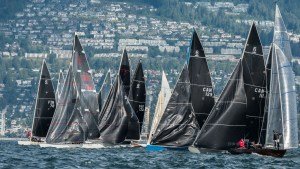
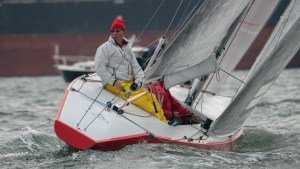
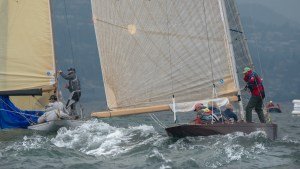
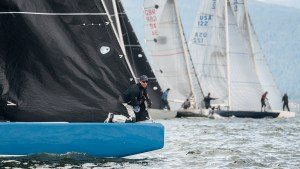
Jan and Skip Anderson (and the pooch Mocha) were on hand to catch the smiles and the start. Please go to her FWB gallery and enjoy the photos. Here are some. Click to enlarge.

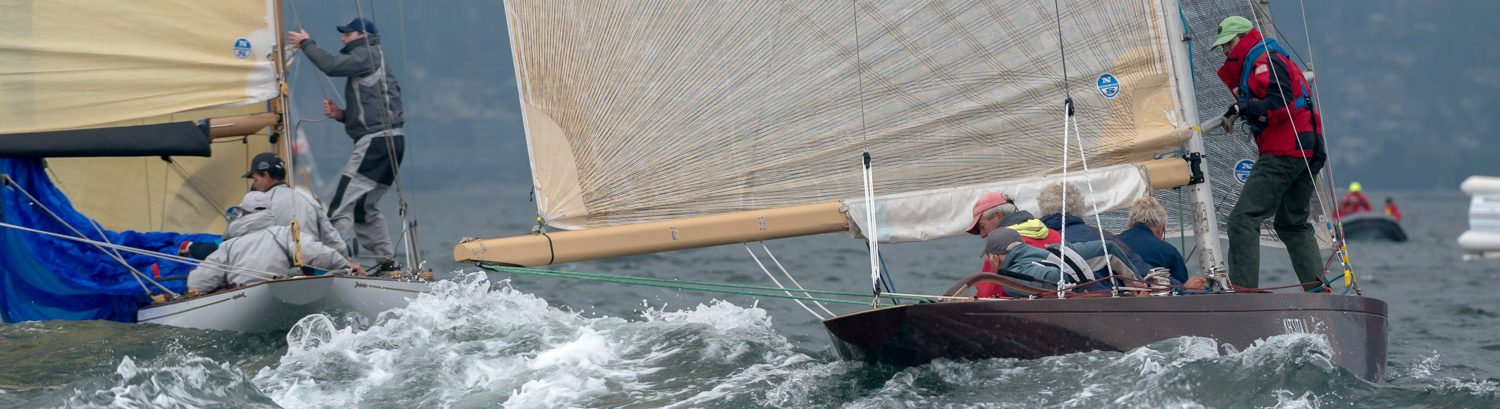
But the real battle of the day took place in Class 2, and it would be hard to find three more different boats in a cruiser racer class. Fittingly, they ended up 1st, 2nd and 4th overall among the monohulls. (Yeah, the catamaran Dragonfly corrected time was in there too but she’s really in a class of her own) I’ll let my friend Gay Morris of the Shark 24 Fayaway (2200lbs) describe his battle with the Perry Quarter Tonner Bingo (4000 lbs?) and Bill Stange’s Westsail 32 Hula (19500 lbs):

Clash of the Titans

Foulweather Bluff 2017 was a very memorable sail for us on the little Shark 24, Fayaway. The race was quick, basically a run and two close reaches. It was not a very challenging course. We started well at the west end of the line and reached west. The tide was ebbing and the 5-6 knot southerly was showing signs of increasing. Soon after the start I looked down and saw the Westsail 32 Hula sailing very well. She had speed on us.

Citroën 2CV, or “Deux Chevaux” in case you were wondering.

They were flying their beautiful pink kite just perfectly and inching ahead all the time. One of the Shark’s weaknesses is downwind in light air. Even with Fayaway‘s penalty spinnaker and double penalty main we could just not keep pace. I told my crew we were being out horse-powered, like a Deux Chevaux against a big Buick. The Quarter Tonner Bingo was going very well too.

Once out west of the Possession Bar most of us gybed toward Scatchet Head. The winds went lighter, maybe 3-4 knots. I remember hearing a train going by Meadowdale and told my crew that we should get an easterly shift. We did and had a good reach for the mark, staying high because of the ebbing tide. Bingo was first around, having sailed a very nice run. Hula was right on their tail a half mile ahead of us.

The reach to Pilot Point was a straight away close reach and the wind built up to 12 knots from the south. Hula moved out again nicely, using her greater waterline.

At the rounding Hula lost a little by going inshore before tacking. Fayaway tacked at the mark and headed east right away. The winds built to about 15. The Shark loves a breeze. They do not point high but do go very fast for their rating. For a light boat they do not slow down in the chop like so many boats do. We eased sheets slightly, hiked hard and went fast, passing four boats on this last leg. Ahead of us Hula went fast and munched through the chop easily. We did gain a couple minutes on the last leg but Hula was too far out there. I guess we ran out of runway. A few more miles and we would have corrected on her. Hula corrected to first overall and Fayaway second overall, about two minutes behind. Bill Stange is an excellent sailor and his crew did a perfect job. It is always a pleasure racing against him no matter what boats are involved. – Gay Morris

And Then There’s This - Take Note Race Organizers!

And we have to include this nice note from John Wolfe of CYC Edmonds:

Dear Kurt,

We Corinthians in Edmonds thank you as editor and Bruce Hedrick as contributor for the spot on forecast which made it easier for our race committee to run a shorter course for the faster boats in last Saturday’s FWB race.

NOAA’s forecast had us all licking our lips for much better than average wind but Bruce Hedrick’s forecast reeled us back to the reality that you have to sail with the wind you have.

Thanks! John Wolfe CYCE

Race Organizers: Bruce has kindly been offering up his weather outlooks and racers and committees respond! The Briefs engage sailors and get everybody thinking about this puzzle that is the Salish sea. Ours, after all, is as much a intellectual sport as it is a boatspeed challenge. And while even a Bruce Brief forecast isn’t always spot on, it helps everyone make better decisions. Please get in touch with me about your event and I’ll beg Bruce to put his thinking cap on for your race - then help me spread the word that the Brief exists. Thanks! -KMH


Bruce’s Brief for PSSC Small Boats - check out the double ebb Sunday!

For the CYC’s Small Boat Series off of Shilshole, it doesn’t look much better on Saturday when you’ll have light and variable breeze. Sunday, however, looks MUCH better with 15-20 knots of northerly in the morning and then dropping off to 5-10 knots of northerly in the afternoon.

Tides will be more interesting for the Shilshole venue especially on Sunday. And no, that is not a typo on Sunday with ebbs back to back.

0742 Max Ebb .47 knots

1242 Slack

1536 Max Flood .95 knots

1806 Slack


Sunday

0830 Max Ebb .44 knots

1224 Max Ebb .12 knots

1342 Slack

1618 Max Flood .87 knots


The tactics for Saturday and Sunday will be highly dependent on where the start line is set. On Sunday if the RC is closer to the breakwater, in the morning think of Thursday evening racing in the summer. On Sunday afternoon think of morning racing in the summer, in other words, more of a slight northeasterly component.

Have a great weekend


Ed. Note, Thanks Bruce for thinking of us “little guys.” It looks like a solid turnout with a dozen J/24s, 11 Lasers, 11 RS Aeros, 7 Moore 24s, 4 Stars and a few other classes as well. Here’s to a competitive racing, even if it is a bit light!

Bruce’s Briefs 6, 7, & 8 Oct. Foulweather Bluff Race out of Edmonds

Our very interesting year of weather continues after a spectacularly beautiful week of true Indian Summer conditions. As we know, it simply isn’t going to last however there is really nothing major league bad in the offing. That, however, is the bad news.

As you can see from the charts, we have a cold front that is rapidly approaching the Pacific Northwest and will blow through the area tonight. The baro is dropping and we are already seeing rain off the north coast on the Doppler. The other feature to note is the incredibly strong high-pressure system (1040MB) off the coast. This will drive a strong onshore flow down the Straits after the cold front passes. Unfortunately, this will create a convergence zone over the Race Course area for tomorrow. As is typical for a post-frontal scenario, the isobars will ease over the Upper Sound and lower part of Admiralty Inlet and while it may be cranking in the Straits, 25-30 knots from the West, the westerly won’t get much past the Marrowstone Light. While there will be enough southerly in the Race area to get the race started, it will tend to get lighter from noon on. The key to this race will be to finish early.

Running the polars for Crossfire, they should finish just after 1300 hours in a dying south-southeasterly followed closely by the TP-52’s. The rest of fleet may struggle a bit as the breeze will continue to drop. Other projected times are:

Beneteau First 40.7 1609

J-105 1648

Farr 1020 1719


The tides will actually be a help. For Admiralty Inlet off Bush Point.

0712 Slack

1018 Max Ebb 2.74 knots

1342 Slack

1612 Max Flood 1.75 knots

1842 Slack


This will be another race that will drive tacticians and navigators crazy as they struggle to keep their vessels in the best wind. The key here will be to keep your head out of the boat and watch which way the smart people are going. For the most part, on the way up to Scatchet Head, simply aim at the mark and sail your polars.

From Scatchet Head to Foulweather Bluff, you will want to stay in the ebb tide and stay out of Skunk Bay where it can get light in a southerly. With any kind of luck, you’ll get around FWB near slack water. Remember that the flood starts first coming down the west side of the Sound and around Point No Point, so watch your COG and SOG. Again, if you’re beating after the mark, stay out of Skunk Bay, there’s a reason why it’s called that….

From Pt No Pt to the finish, have your barber-haulers and light air sheets rigged and ready and aim for the finish. Given a choice between going due east or down the Sound on the west side, stay to the west. Just don’t overstand the finish and keep yourself between your competition and the finish line.

Remember, all of this presumes a long course. The committee has two other options if it looks like it’s going to be really light.

The rest of the weekend really looks OK with the only really breezy conditions being in the Straits. While we’ll tend to have a southerly over the Sound on Saturday, this will shift to a northerly on Sunday. In other words, Stay in Edmonds, enjoy the post-race activities and the sail home on Sunday.

Take a peek also at the surface chart for 10 October. If you were impressed with the 1040MB High, you’ll love the 1043MB monster that’s projected. It also shows another weak cold front coming over us. None of these will produce much rain however it will be getting cooler in the evenings.

Be Safe and enjoy the weekend.


Laser Worlds, J/24 Europeans Success for Northwest Sailors

It is so fun to applaud the success of Northwest racers when they go out in the world! Over the past week we can claim some more of that success, though to anyone who’s been paying attention it won’t come as surprise.

Bill Symes atop the podium.

Bill Symes of Portland won the Great Grandmaster aged (65+) Radial fleet in the Laser Master Worlds in Split, Croatia. He did it in convincing fashion, winning four of the seven races, including the last three. Those of us who get to race against Symes know how much he contributes to the sport, what great sportsman he is and how ridiculously consistently fast he is. He is extremely deserving of this win!

Al Clark of Vancouver has coached young Vancouver athletes for several years and has been taking aim at the Master Worlds for many years. He won this year’s Standard Grandmaster (55+) division in a hard-fought battle with fellow Canadian Andy Roy.

And then there’s Diedre Webster, also from Vancouver. She was third in the women’s Great Grandmaster (65+) fleet. But wait, she was the only 75+ woman in the fleet, so that pretty much makes her the winner (a hero) of that class!

I hope to get some first-person details to share in the not-so-distant future.

The Laser Masters Worlds is a truly amazing event. Every year, more than 300 “old folks” get together somewhere in the world to race these deceptively simple, physically brutal, little boats. You can hear swearing in several different languages as one side of the course gets hit by a bad shift. To sail a Laser in breeze at any age is a challenge, to do so when your’re 60, 70 or more is amazing! And at the top of these fleets, the level of skill and fitness is absolute tops.

The Master Worlds is my personally favorite regatta. The sportsmanship and camaraderie is tops, the international aspect is remarkable and racing is always top notch. I was particularly pleased to see the number of women racing at the Worlds this year. It seemed to be more than in years past.

Results.


J/24 European Championship


Whittemore’s Tundra Rose winning US Nationals earlier this year in Seattle.

Keith Whittemore loves sailing J/24s on Tuesdays on Lake Washington. He also loves sailing them in Europe. He’s had a great year, first winning the Nationals here in Seattle in May and last week winning the Europeans in Hungary last week with a remarkable comeback win.

According to Whittemore’s emails to his J/24 compatriots, it was light and shifty conditions. On day 2 (?) he had a rough day, having to fight back from a bad start to finish 7th, suffering a black flag DSQ for the second race of the day and then watching the last race (which he was winning) abandoned. Despite all that, he eventually was able to drop the DSQ and rack up three thirds in the last four races to claim victory. Results.

In the meantime, other Seattle J/24 racers were making their mark at the World Championships in Port Credit, Ontario. Mark Laura’s Baba Louie ended up 7th , Scott Milne with Tremendous Slouch finished 10th and Carl Sheath finished 30th in Suspence.

I’m hoping to share some insights from the competitors themselves in the coming days.


Sensory Deprivation on the Cockpit Floor in the Six Meter Worlds

There’s no doubt that the 6-Meter Worlds in Vancouver September 15-21 was an extraordinary, red-carpet affair and not really weekend sailor fare. Boats and luminaries were shipped from Europe, boats resuscitated and re-wardrobed, pros were lined up for most of the boats. It’s not often there’s real-life royalty on the start line.

But what’s it like to sail a 6-Meter? I gave a shout to Alex Simanis of Ballard Sails who was main trimmer aboard Bob Cadranell’s Arunga.

“In my spot it was like sailing with sensory deprivation,” he explains. “I didn’t see any of the beats. I was sitting on the floor of the open cockpit tending the mainsheet, runners, traveller and the trim tab. As soon as we’re doing 5 knots you used the trim tab, just a little to make the keel a bit assymetrial going upwind. As the main trimmer you get kicked in the face a few times because you share the space the owner.”

Click on these Nancii Bernard photos to enlarge. I’d highly recommend going to her web site to see the rest of her photos - they provide a great feel for the sailing part of the regatta.

Some of the other things Simanis explained were that there was a real issue with the boats trying to sink themselves when they got going downwind. It was more than the meter-type hull settling deep into displacement mode, it was more like self-destruction. The wing keels on some boats are actually aimed to drive the boat into the water. “We took on a lot of the water - it came over the floorboards. We were pumping with the biggest Whale pump they make!”

And Simanis added that these boats can be handful when it blows. “It’s physical,” he says. The boats usually sail with five. “Twenty knots is about the limit for these boats,” he adds, “After that it just gets stupid.”

Arunga was in the modern class, but the “classic” class was equally competitive. The royalty (HM the King of Spain) won the classic classic race, and the Swiss boat Junior defended her title, but not without controversy. Chris Winnard, who happened to be sailing on Arunga, laid out some of the controversies in this Sailing Anarchy post.

Simanis agreed that things smelled, at the very least, fishy when the hot local Canadian New Sweden was given some questionable redress. “18 boats filed protests, and eventually they just rolled it into one protest with 18 witnesses,” Simanis explained. He added that the program Ben Mumford and Don Marten had put together didn’t really need any help - the boat was well sorted and fast. In the end the redress was not given.

Of course, high falutin or not, it’s still a sailboat race and everyone tries to come away learning a thing or two. The Arunga team, for instance, learned a fair bit about mast rake. They learned they needed a lot more than they’d been using, though in the end had to moderate the change just a bit. The whole “bow down” thing to maximize speed isn’t necessarily the thing to do, as the fast boats were all sheeting in hard and pointing on the beats.

While the real competition is in Europe, this region has a proud history, and present, with 6-Meters. There are several boats in Port Madison, and they often turn up for Seattle buoy races. Then there are the Vancouver boats. With all these boats tuned up after the Worlds, there may be a renewed interest in the class around here.

It would be a great game to play, because while they’re sailed boat for boat, every one is different and needs it’s own customization. Optimizing the boat is certainly a big part of the game. And underway, who wouldn’t like to on that good looking a boat going to weather?

Few if any boats are more beautiful than the narrow, low slung meter boats. I grew up watching some of the ex-America’s Cup 12-Meters like Heritage charging upwind unmolested through those nasty boat-stopping lake waves. It was as sight to behold. And if you spend some time looking at the photos and squint a bit, you can see a bit of the “old” Cup racing.

“I’m a sailor who believes in planing boats, but it’s cool to be sailing part of history,” Simanis says. Even if it means you miss seeing where you are on the race course during the beat.


Racing Wrapup: 6-Meters, US Offshore, J/24s and the Mighty Cal 20

A few racing events happened over this past weekend in addition to the scholastic event we covered yesterday.

US Offshore Championship

Back on the East Coast a group of local sailors led by John Leitzinger did battle in the US Offshore Championship sailed out of the Naval Academy in Annapolis. While he was runner up in the same event 18 years ago, things weren’t as successful here with a 9th place finish. We’re hoping to get the onboard lowdown from the Northwest boat in the coming days.

There was a Northwest connection to the winning boat Meat representing Chicago. Paul Bersie, who hails from Chicago, reports that her boyfriend Brian Davies is a regular with that team and was onboard for the event. (She would have been there except for her Fisheries Supply duties!) From his view, the Puget Sound team had some bad breaks, but otherwise could have been right up there. An interesting side note, the crew onboard Meat included a 26-week pregnant woman! Bersie reports: “She’d said they kept asking her at the yacht club if she was nauseated from sitting on the spectator boat. Haha! I’m sure she had a great time telling them that she was, in fact, also racing.” Results.


J/24 Worlds

The J/24 Worlds were held in Port Credit, Ontario, with 63 competitors. Northwest competitors again were in the hunt with Mark Laura’s Baba Louie ending up in 7th , Scott Milne with Tremendous Slouch in 10th and Carl Sheath in Suspence in 30th. If any of the skippers or crew want to share some of the story, just email me and I’ll get it online. Results.

6-Meter Worlds

This was truly an epic event. There were 45 boats in two classes, “modern” and “classic.” The most “modern” boat was from 1995 and the most classic was from 1928. His Majesty Don Juan Carlos de Borbon from Spain won the classic division. Phillippe Durr won the modern class. The top Northwest boat was Bainbridge Island’s Peter Hofmann in Goose in the classic class. I’m hoping to get some more insight into the event in the days to come. One thing for certain, luminaries were drawn to this events like moths to the light, and while the world ponders its next foiling boat, the elegance, class and competitiveness of this fleet stood out. Results.

Cal 20 Fleet Championship

It may not be king’s boat, but the Tacoma Cal 20 fleet had its Fleet Championship over the weekend in very light winds. The little Lapworth design moves along even in the light stuff and, most importantly, a lot of fun was had.


Gridley and Timms Win NWISA Singlehanded Championships

Northwest Interscholastic Sailing Association Singlehanded Championships

Photo by Jim Skeel

It wasn’t the breeziest of regattas, but the high school singlehanded championships were sailed over the weekend off Shilshole Bay Marina in Seattle. The winners were Grant Gridley in the Radial class and Owen Timms in the full rig class. University sailors got their own Radial and full rig fleets. Congratulations to all who participated. BTW, I’m pleased to report that the Seattle Laser Fleet provided a number of boats in support of this event.

Here’s the report from the NWISA:

Saturday, September 23:

Competitors from around the Northwest were greeted by a light southerly on Saturday morning. This proved to be quite stable and peaked around 8 knots by noon. The breeze then began to fade, and by 3pm it had shut off completely. We were fortunate to complete 6 radial and 7 full rig races in that time, alternating between double lap windward/leewards and trapezoid courses. The 20 boat Laser Radial fleet especially was very competitive. This resulted in at least 8 general recalls (we lost count) and most of the later starts under I-flag.

Sunday, September 24:

The forecast for Sunday looked bleak, and after a shore postponement competitors left the dock at 11am to try racing in a fragile northerly. The breeze was just strong enough to start a Radial race, and it maintained a 3-4 knot average until most competitors had finished. After it fizzled out, competitors waited around on the water for another hour and a half before the Race Committee called racing for the day. NWISA is excited to send representatives Owen Timms and Per Black in the Full Rig and Grant Gridley and Abbie Carlson in the Laser Radial to St. Petersburg, FL later this fall. They will do a terrific job representing our conference. Big thanks to all the volunteers and race officials this weekend. The regatta was well run and made the most of our limited racing windows.

More Photos by Jim Skeel. Click to enlarge.

US Sailing just sent out their Youth Sailing newsletter. Take a look.

Paul Bieker Moves On from the 35th America’s Cup

“Right now I’m not really all that interested in the next America’s Cup.”

Paul Bieker’s response is understandable. He poured untold hours and no doubt part of himself into the ridiculously fast AC catamarans over the last couple of years. They did everything (and more!) than could be expected, and now the class is being cast aside as the Kiwi Cup holders and the Italian Challengers of Record come up with a new monohull class.

The Seattle designer has been with Oracle since the last time monohulls were used in AC 32 in 2007. He was there through Oracle’s challenge that wrested the Cup from Ernesto Bartarelli, with the resounding win by the massive trimaran USA-17 He’s always had a big hand in the engineering, and the boats have all held together amazingly well. During the last Cup in Bermuda, he had a much bigger hand in the design, coming up with the platform, foil and wing locations and myriad other details that kept the speedsters moving.

“I’m proud of the boats we did in Bermuda” he says, which is a lot coming from a man who doesn’t like drawing attention to himself. The boats sailed well in 7.5 to 22 knots and were foiling around the course in 8 knots of wind. During the previous Cup they thought it would take 16 knots for that kind of foiling.

Of course Bieker would have liked to see the next Cup sailed in similar boats. “There’s a lot of room for the catamarans to get even better,” Bieker says. “It’s sad to see all the progress we made thrown aside.”

As it stands nobody, not even Bieker, knows what the next boat is going to look like. A couple things seem certain. The boats won’t be as fast as they were this year and if they go with soft sails they’ll be a lot more expensive than a fixed wing.

Tweaking the Oracle

Oracle did get faster during the finals and, as happened in America’s Cup 34, Bieker had a hand in it.

There were three major changes that added speed, but together they weren’t enough to make the kind of comeback the 72-footer made in 2013 with the 72-footer.

“We caught on to a few things our analyses didn’t get right,” Bieker explained. The first of these was weight. The analysis said getting down to the minimum wasn’t that critical, but in real life it was. So Oracle went on a diet to get to minimum.

Another area was the rudder wings, which were at the maximum size to help with righting moment. It turns out that cutting them down to reduce drag a bit was more helpful than the extra righting moment.

Finally, Bieker added to the tips of the high-speed foils to extend their range into the lower winds.

The changes made Oracle a bit faster and noticeably more skittish. It wasn’t nearly enough to keep pace with the well-oiled Kiwi machine.

Did You Know

Did you sailish.com readers know that righting moment was provided by the wing sails?

Huh?

Yes, it turns out that in higher breezes up to the top third of the wing sail was “inverted” so that instead of providing force on the windward side of the sail, force came from the leeward side of the sail to provide righting moment.

Toto, we’re definitely not in Kansas any more.

Bieker explained that the reason there were few bear-away crashes was that during the maneuver a good part of the sail was pushing the boat upright. The little pull aft was outweighed by the benefit of added righting moment. This is just one of the reasons Bieker sees a lot of potential in wing sails. And he definitely sees foiling potential for Corinthian fleets – even in light wind areas like the Salish Sea.

Personally, I thought main trim was challenging enough already.

Moving On

While the Cup has dominated much of his time, Bieker has plenty to keep him busy. I’d guess that he’ll be quite happy with non-Cup projects for a while.


We have already seen what he can do when unleashed on the performance catamaran Fujin. He’s currently working on some modifications to speed her up even more.


Perhaps the biggest project is a 53-foot cat taking shape in Rhode Island. This will also be a semi-foiling cruiser-racer, and will build on what’s been learned with Fujin.


He’s putting together a foiling Moth from scratch. While Bieker’s International 14s sit atop that class, this is his first foray into the Moth world. While we’re still not seeing many Moths in the Northwest, they’re definitely a force on the international scene. Two hundred forty competed in this year’s world championship in Lake Garda, Italy.


Then there’s the Aussie 18 class. Bieker has been asked by the class to come up with a foiling conversion. Already barely touching the water downwind without foils, they want to break completely free. Expect some exciting video to come out as those Aussie 18 sailors start to play with their revamped toys.


Then there’s a project that’s just waiting to happen. “Foiling powerboats are a no-brainer,” explains Bieker. “It’s a lot harder to make a sailboat foil with all the variables than a powerboat.”


Why make a powerboat foil when you can just add horsepower to make it faster? Fuel efficiency. “You could burn a quarter to a fifth as much fuel to get the same speed,” says Bieker. And chances are the ride would be smoother as well.


But alas, that project-in-waiting will probably have to wait for fuel prices to go up or the right client to come knocking.


A Blue Winter


The Bieker designed Blue is coming back to the Northwest for some racing. She was built by Jim Betts and spent some shakedown time here as a newborn, but lives full time on Lake Michigan where she’s a regular in the Mackinac races and the local Milwaukee scene. It’ll be good to see her again after her battles with the Santa Cruz 70s (and others) on the Lakes.


Tasar Worlds - From the Inside

By now most of us know that Jonathan McKee and Libby Johnson-McKee won the 2017 Tasar Worlds in Japan at the beginning of August. I kept hearing about what a tremendous event it was and was hoping for a “booties in the cockpit” report to share with Northwest sailors (and sailors from all over, really) Mike Karas, who with Molly Jackson finished 7th, graciously offered up these thoughts. For those of you keeping score at home, when you count Jay and Lisa Renehan, that puts three PNW teams in the top 10 of a 97-boat fleet! Here’s Mike:

Simply put, it was one of the best regattas I’ve ever been to. From the level of racing, to the race committee work and social functions, this regatta has set a very high bar in my eyes for all future events.

The racing was tough - physically as well as mentally. With the beats just shy of 1 nm, the total distance sailed per race was around 6nm. Target time for each race was 1 hour, and no elapsed race time for the leaders deviated more than a few minutes off this target. The amazing thing is every day had very different conditions. We raced in every wind speed from 5kts to 22kts.

The temperature was hot and muggy. High humidity made 90 degrees “feel like” 103 degrees at 10:00 in the morning. The water was around 80 degrees, so not too refreshing when you got splashed. The sea-state was usually quite lumpy with a short steep chop.

There is a bunch of great photos here:

https://junhirai.photoshelter.com/gallery-collection/2017-Tasar-World-Championship/C00003NeKModIzOI

And here’s a good one of us:

https://junhirai.photoshelter.com/gallery-image/Tasar-worlds-Day3/G0000I75pVKvCsUw/I00000c9U7UM2R18/C00003NeKModIzOI

Here are some of our personal photos:


The McKees sailed an extremely strong regatta, sealing the win with two races to spare, I believe.

The camaraderie of the Tasar fleet, as always, was top notch. Everyone is there to have a good time, and that makes sailing a regatta like this very enjoyable.

Above all, my biggest impressions from Japan were the kindness and hospitality of the Japanese. And it wasn’t just the sailors, but everyone. It really made the trip exceptional.

–Mike Karas

Ed. Note: Karas won the US Tasar Nationals in 2013, was a US Sailing Team member from 2003-2006 and is competitive in every boat he touches.

Yanez Repeats at the 2017 Dale Jepsen One Design Regatta in Bellingham

Yanez Repeats at the 2017 Dale Jepsen One Design Regatta in Bellingham

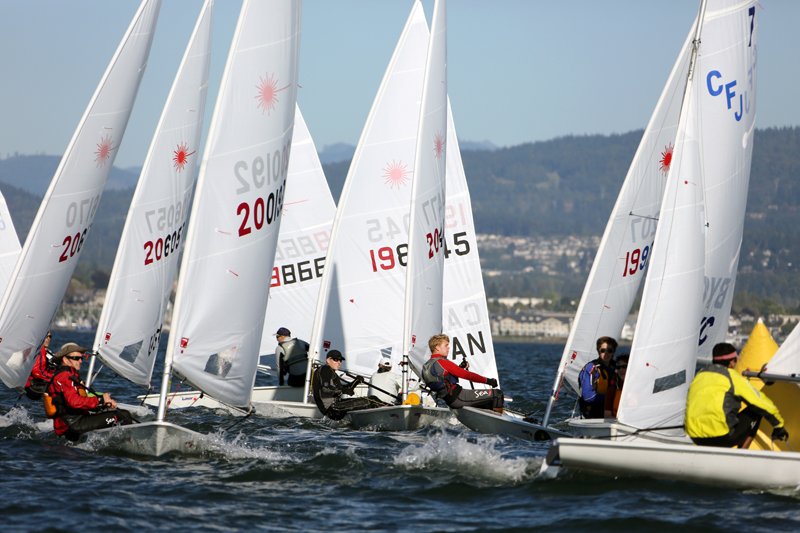
It was a small but mighty fleet of Lasers at Bellingham Yacht Club’s Dale Jepsen One Design regatta this year. Jorge Yanez, the winner of the DJOD last year and the winner of the Laser Radial Masters Nationals event in the Gorge this year was there; the winner and runner up from 2015, Sascha Smutny and Doug Honey were there; and Perham Black, fresh off his win at the Bellingham Youth Regatta was there. The top of the 9-boat fleet was so evenly matched that places changed at nearly every mark rounding.

This is a photo from the Laser fleet in a previous Dale Jepsen Regatta.

Mike Johnson lead the regatta after two races with a first and a third for four points, followed closely by Yanex and Black with five points each. Yanez jumped out after that with two firsts in races 3 and 4, establishing a five point lead on Black. Undeterred, Black went hard right on the last beat of the last race, jumping past several boats and winning the race. Yanez finished 4th to save the regatta win by one point. If he had been 5th, the tie breaker would have gone to Black.

Third place went to Mike Johnson with only 4 points separating third through sixth places. It is for this kind of tight racing, often overlapped with other boats at every mark rounding and multiple boats arriving at the finish together, that we keep showing up. There were no protests, no starting line abuses, and only a few capsizes. Racers compared their ideas after each race were clearly glad to be lucky enough to be having fun among friends.

Results here.

Regatta chair Mike Poulos, race officer Jonathan Knowles and their terrific volunteers, did a great job under difficult circumstances to choreograph five well-run and fair races. All races occurred on Sunday due to no wind on Saturday. Saturday had been the regatta organizer’s nightmare. Just enough wind to leave shore that went flat at the first warning, and then came back up 10 minutes after all boats got back to the parking lot. So on Sunday, everyone was elated to see a sunny 8 to 12 knot southeasterly materialize from the glassy bay – less than an hour before the first warning. The breeze held nicely right up through the last race and then died.

It is interesting to note that only three participants at the event this year were also at the event last year. Some could say we lost the others but the positive perspective says we gained several new people. Let’s build on that momentum and have some great events this fall. We could have a start at Corinthian’s PSSC (October 7-8) and Turkey Bowl (November 18-19). Would it be crazy to imagine 15 Laser’s on the starting line?

–Jay Leon

Ed. Note: I’d love to post something on the FJ and 505 fleets, so if anyone wants to share some words or photos, send them along and I’ll get them in. Also, thanks to Jay for the Laser report. No, indeed, 15 Lasers is not too many to expect for for PSSC and Turkey Bowl, especially if the great young sailors show up. Maybe both full rig and Radial fleets? Note this video from the Junior Olympic Regatta.